 KemetLeads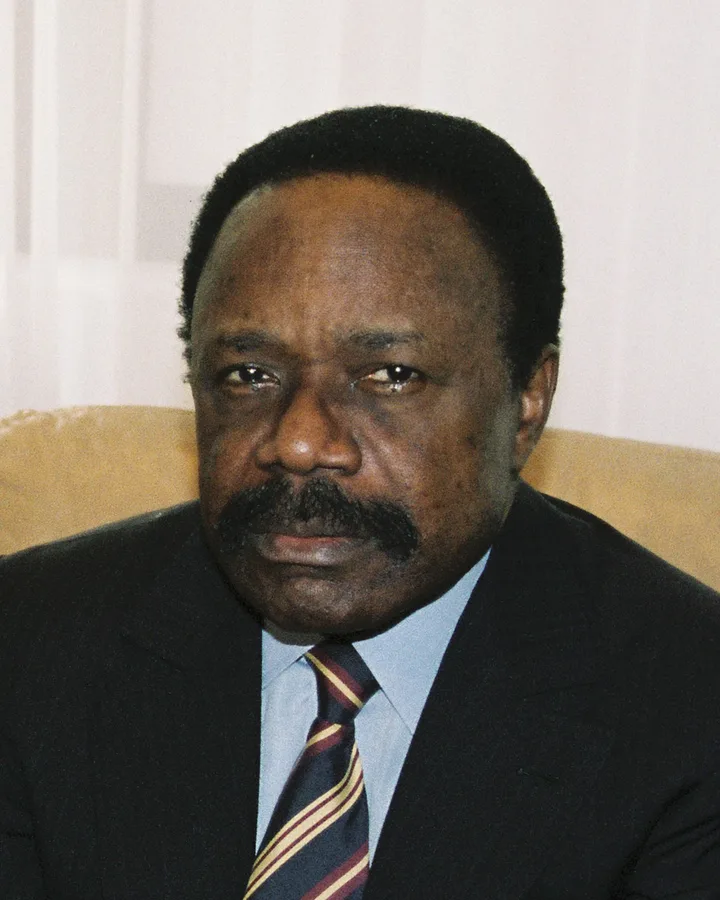
Omar Bongo Ondimba
Forty-one years in power, a Paris address book, and the man who defined Françafrique.
KemetLeads Scorecard
How we score →Hand-picked successor who took over constitutionally in 1967, then ran a one-party state until 1990 and removed term limits in 2003; died in office in 2009; oil-funded stability shadowed by clientelism.
P = percentile among the other African countries over the same years. Rows 1–4 are country-level change during the tenure — evidence, not proof.
Our read
Forty-two years that look average on every country row — development P52, democracy P51, rights P40 — which, for an oil state with Gabon's income, is the point: the money stayed at the top. Term limits removed in 2003; died in office.
Power 1967–2009
A 2003 amendment removed the two-term limit; died in office in 2009.
Sources: Archigos 4.1 (Goemans, Gleditsch & Chiozza) · Powell & Thyne coup data V2026.08.29 · term-limit conduct coded by KemetLeads
The rise
Born Albert-Bernard Bongo in a Téké village in 1935, he served in the French air force and joined the civil service after independence. Léon M'ba made him his chief of staff and, at French urging, vice-president; when M'ba died in November 1967 Bongo became president at 31, one of the youngest heads of state in the world.
What they did
Oil, manganese and timber made Gabon one of Africa's richest countries per head, and Bongo used the money to buy peace: a one-party state from 1968, then, after the 1990 riots, a multiparty system he still dominated. He mediated conflicts across Central Africa and made Libreville a diplomatic hub, converting to Islam in 1973 and taking the name Omar.
The full picture
Elf's political slush funds ran through Libreville, and the French 'biens mal acquis' investigation counted 39 properties, 70 bank accounts and a fleet of luxury cars bought with Gabonese public money. Most Gabonese stayed poor, elections were rigged and opponents were co-opted or jailed. His son Ali inherited the presidency in 2009 and held it until the 2023 coup.
Why it matters
Bongo is the reference case for how a former colonial power and a client ruler can lock a country into dependency for decades. Understanding him explains the anger behind the 2023 coup, France's fading sway in Africa and the fragility of dynasties built on oil.
“Gabon without France is like a car with no driver. France without Gabon is like a car with no fuel.”