 KemetLeads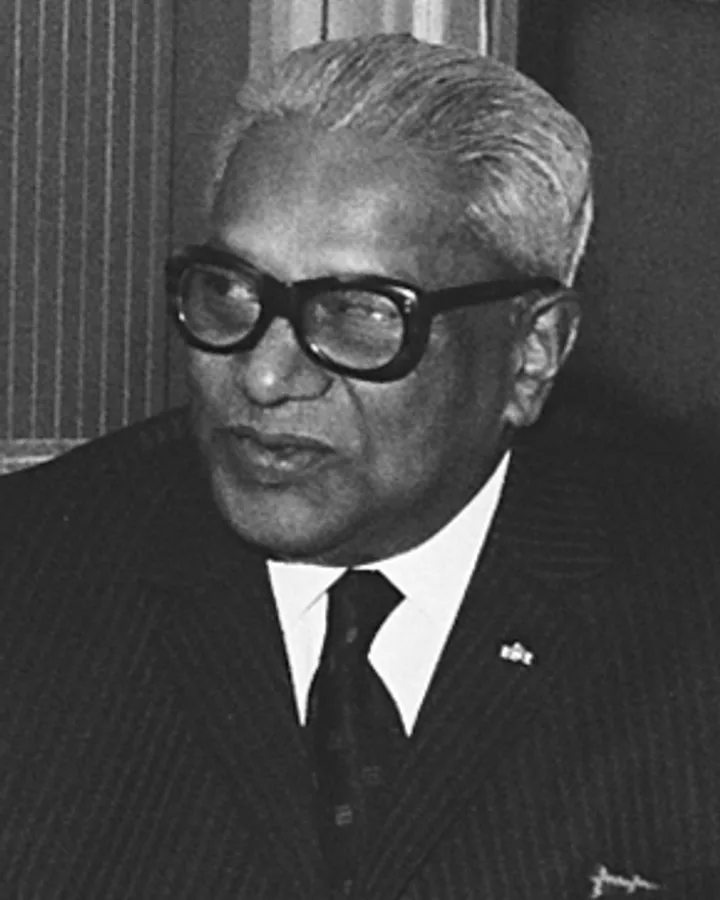
Sir Seewoosagur Ramgoolam
The indentured labourer's son who talked a divided island into independence.
KemetLeads Scorecard
How we score →Elected father of the nation who built the welfare state and free schooling; postponed the 1972 election under a state of emergency, but conceded the 1982 sweep and handed over — a first in Africa.
P = percentile among the other African countries over the same years. Rows 1–4 are country-level change during the tenure — evidence, not proof.
Our read
Democracy at P81 and a welfare state on a sugar island: the numbers reward the founder. The postponed 1972 election costs him half a point on conduct; conceding the 1982 wipe-out and handing over — a continental first — earns most of the 4.4.
Power 1968–1982
Parliamentary system without term limits; lost the 1982 election after 14 years.
Sources: Archigos 4.1 (Goemans, Gleditsch & Chiozza) · Powell & Thyne coup data V2026.08.29 · term-limit conduct coded by KemetLeads
The rise
Son of an indentured labourer from Bihar, Ramgoolam walked barefoot to school, qualified as a doctor in London in the 1930s and returned to practise in Port Louis and join the Labour Party. Elected to the Legislative Council in 1940, he built a movement of Indo-Mauritian workers around universal suffrage, becoming chief minister in 1961 and premier in 1965.
What they did
Against a Franco-Mauritian and Creole opposition that feared Hindu dominance, he won the 1967 election and led Mauritius to independence on 12 March 1968, inside the Commonwealth. He introduced free secondary education in 1976, old-age pensions and a welfare state, and diversified from sugar into an export-processing zone that laid the ground for the 'Mauritian miracle'.
The full picture
Independence came at the price of the Chagos archipelago, detached by Britain in 1965 with his government's acquiescence and its people deported, a wound still open today. His later years brought economic crisis, a state of emergency from 1971 to 1976 and accusations of nepotism; in 1982 his coalition lost every single seat to the MMM.
Why it matters
Ramgoolam showed that a plural society could be governed by bargaining rather than by one community's dominance, and Mauritius' stability and prosperity still rest on that settlement. His son Navin has since served repeatedly as prime minister, keeping the family at the centre of Mauritian politics.