KemetLeads
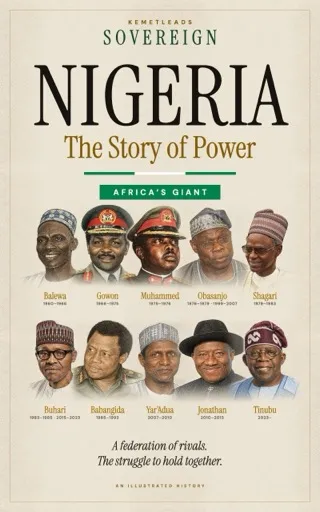
Sovereign: The Story of Power in Nigeria
Africa’s giant, still learning to walk on its own feet.
At midnight on 30 September 1960, at the Race Course in Lagos, the Union Jack came down and the green-white-green flag went up. Nigeria began its life as the largest nation in Africa, a federation of three regions that were stronger than its center. Its first prime minister, Abubakar Tafawa Balewa, said the country had “awaited it with increasing impatience”. What followed was sixty-six years of trying to prove an old remark wrong, that Nigeria was “a mere geographical expression”: two coups in 1966, a civil war that killed perhaps a million people, twenty-nine years of military rule, the annulment of the freest election in the country’s history, and, in 2015, a sitting president who lost and telephoned the man who had beaten him.
Sovereign: The Story of Power in Nigeria tells that story as a story — chronological, human and sourced — and reads it for the strategies its leaders chose, in seven acts from The Fragile Federation to Change and Renewed Hope, up to 12 September 2026, when the electoral commission published the final list of eighteen candidates for the presidential election of 16 January 2027.
Inside
- A prologue on 31 March 2015: the telephone call that conceded defeat before the result was declared.
- The deep past, from the Nok terracottas and the bronzes of Ife and Benin to the Sokoto Caliphate, the sack of Benin in 1897 and the road to independence.
- Leadership read as strategy: each ruler’s playbook named, the African peers who stood at the same fork, and nine Lessons in Leadership argued from the record.
- 109 source notes, a reader’s guide of 146 entries and an epilogue on the latest official data to mid-October 2026.
A clear, sourced introduction for anyone who wants to understand Nigeria and how the largest democracy in Africa set the precedent that a president who loses goes home.
Read it on Kindle →