 KemetLeads
ANC falls to 32% in South Africa's local elections — the voters came out to leave it
ANC falls to 32% in South Africa's local elections — the voters came out to leave it
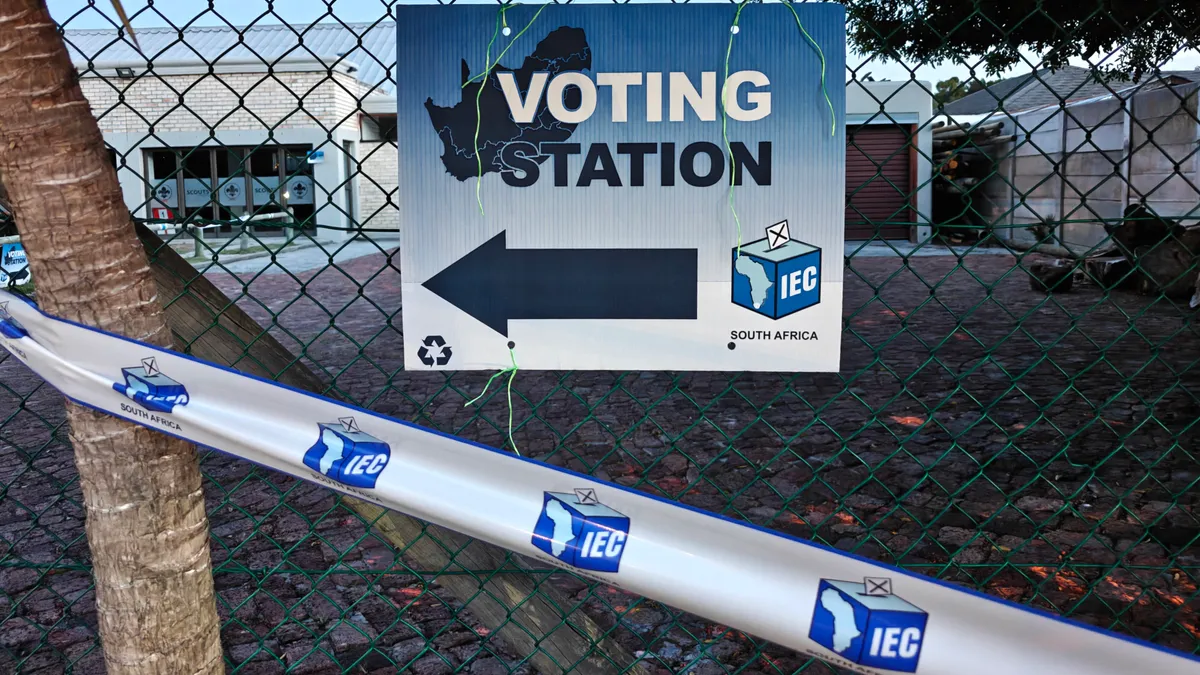
South Africa voted on 4 November in its seventh local government election, with 29.2 million registered voters, 546 parties and nearly 137,000 candidates for 257 councils (SAnews, 2 November). With 87% of the 23,696 voting districts counted by mid-afternoon on 6 November, the ANC had 31.9% of the proportional vote, the DA 24.2%, Jacob Zuma's MK 9.4% and the EFF 6.3%, on a turnout of 51.3% against 45.9% in 2021, when the ANC took 45.6%; the DA led in six of the eight metros, MK in eThekwini and the ANC in Buffalo City alone, and the IEC declares the result on Sunday 8 November (The Outlier, from IEC data).
The reflex reading is a ruling party collapsing; the data says something harder. Turnout rose five points and the ANC's vote fell fourteen — the 2021 stay-at-homes came back and voted for someone else, which is also how Oxford Economics' Louw Nel reads it: ANC voters “did not stay away – as many expected – but rather showed up and voted for alternative parties” (Reuters, 5 November). That is the shape our Scorecard has given Cyril Ramaphosa's South Africa since 2018: conduct 4.2 out of 5, democratic trajectory at the 72nd percentile of African countries — the electoral democracy score held flat from 2018 to 2025 while the median African country's fell — and development delivery at the 10th, with GDP per head down 4% to 2022 while the median rose 1%, and life expectancy up 0.4 years against 1.8. A country at P72 on democracy and P10 on delivery is precisely one where the ruling party loses: the institutions are strong enough to count it out, and the services weak enough that voters want to. We wrote on 28 July that 2026's ballot year is a referendum on how leaders leave, and on 13 September that Ramaphosa's test before 4 November was whether voters would hear of a prosecuted ringleader rather than a scapegoat; what they heard instead, two days before the vote, was Ramaphosa conceding that municipal failures had eroded trust in democratic governance (SAnews, 2 November) — an honest diagnosis the ballot then countersigned. The ANC's chairperson Gwede Mantashe answered the count with “major areas, townships, and other areas have not been counted yet” (Reuters); at 87% the IEC's own tally will say by Sunday whether that is a forecast or a hope. The real test is not the declaration but the fourteen days after it: seven of eight metros with no party near a majority, Johannesburg on its sixth mayor in four years, and a party at 32% deciding whether it governs cities as a junior partner or leaves them to the coalition arithmetic it used to set.
The IEC's declaration on Sunday 8 November, then the fourteen days councils have to elect mayors and speakers — whether Johannesburg, Tshwane and eThekwini each seat a mayor by 22 November, and with which partners.
SourcesElectoral Commission of South Africa (IEC), 2026 Local Government Elections results dashboard · SAnews (government news agency), President urges voters to turn out for Local Government Elections, 2 Nov · The Outlier, local elections 2026 results from IEC data (87% of voting districts, 15:14 SAST), 6 Nov · Reuters (via CNBC Africa), ANC narrowly leads DA in early results — Nel, Zille and Mantashe quotes, 5 Nov · Al Jazeera, South Africa's ANC on track for new lows in local polls, 5 Nov
More from the Brief
 Russia–Africa summit ends in Moscow — 48 delegations, 21 leaders, three texts adopted
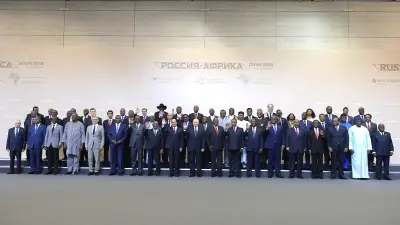
Vladimir Putin closed the third Russia–Africa Summit in Moscow on 29 October with three texts adopted — the Moscow Declaration, a Partnership Forum action plan for 2027–2029 and a declaration on artificial intelligence — and told the plenary that Russia has military and military-technical agreements with 45 African countries (Kremlin, 29 October). Forty-eight delegations came; the Kremlin had announced 22 heads of state (TASS, 26 October), AP counted about 20 and Putin said 21 at his closing press conference, against 43 at Sochi in 2019 and 17 in St Petersburg in 2023.
12 sources
 Lumumba said history would speak — in Congo this week, two men grabbed the pen
On 13 October Joseph Kabila — president from 2001 to 2019, sentenced to death in absentia for treason by a military court in 2025 — launched the Front for the Refoundation of the Nation (FRN) at a news conference in rebel-held Goma, taking the head of a coalition that includes the Rwanda-backed M23, with the AFC's Corneille Nangaa among his deputies (Al Jazeera, 13 October). Two days later Interior Minister Jacquemain Shabani banned the activities of 13 political parties across the country, including Kabila's PPRD and Augustin Matata Ponyo's LGD, in a notice that states no legal ground, duration or dissolution (Actualité.cd, 15 October).
3 sources
 Mozambique's Rome peace turns 34 — it held by turning an army into a party
On 4 October 1992 in Rome, President Joaquim Chissano and Renamo's leader Afonso Dhlakama signed the General Peace Agreement that ended 14 years of civil war; a UN mission of some 6,500 troops and observers then oversaw the demobilisation of more than 76,000 soldiers and Mozambique's first multiparty elections, held from 27 to 29 October 1994, in which Renamo won 37.8% of the legislative vote and Dhlakama 33.7% of the presidential one (United Nations, ONUMOZ). Renamo returned to arms in October 2013 after a government raid on its camp, and a new accord was signed in Maputo on 6 August 2019 by President Filipe Nyusi and Renamo's leader Ossufo Momade (Mail & Guardian, 8 August 2019).
3 sources