 KemetLeads
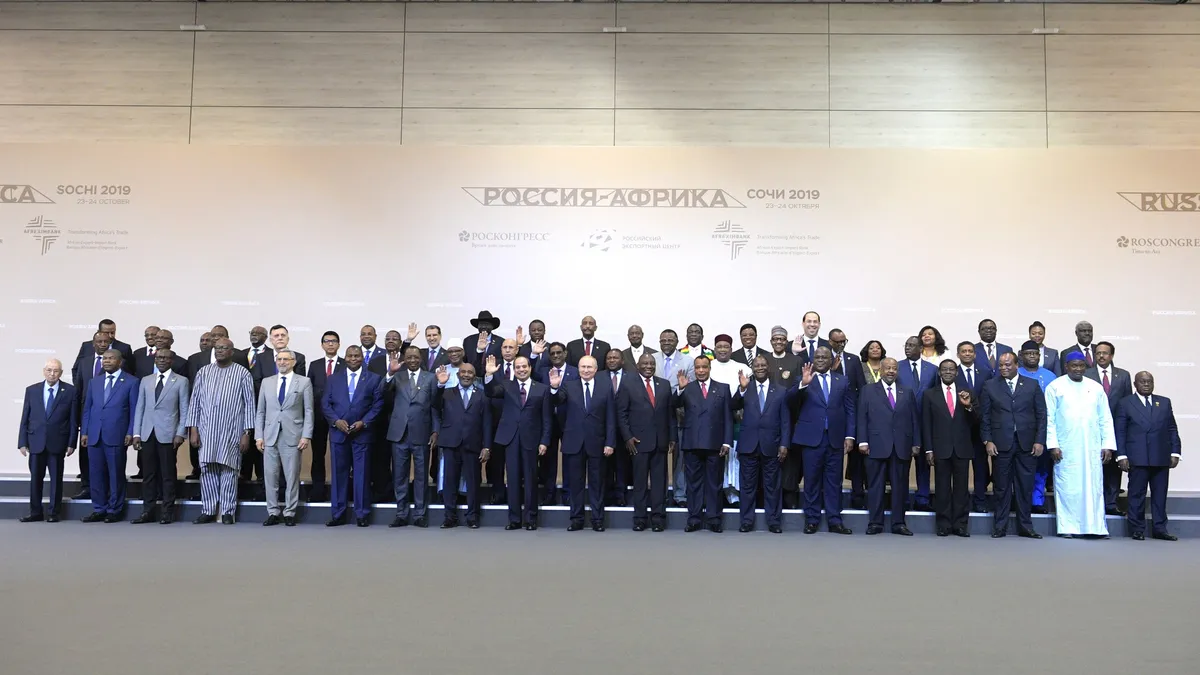
Russia–Africa summit ends in Moscow — 48 delegations, 21 leaders, three texts adopted
Russia–Africa summit ends in Moscow — 48 delegations, 21 leaders, three texts adopted
Vladimir Putin closed the third Russia–Africa Summit in Moscow on 29 October with three texts adopted — the Moscow Declaration, a Partnership Forum action plan for 2027–2029 and a declaration on artificial intelligence — and told the plenary that Russia has military and military-technical agreements with 45 African countries (Kremlin, 29 October). Forty-eight delegations came; the Kremlin had announced 22 heads of state (TASS, 26 October), AP counted about 20 and Putin said 21 at his closing press conference, against 43 at Sochi in 2019 and 17 in St Petersburg in 2023.
Putin held one-on-one talks with, among others, Mali's Assimi Goïta, the Central African Republic's Faustin-Archange Touadéra, Sudan's Abdel Fattah al-Burhan, Kenya's William Ruto, Ethiopia's Abiy Ahmed and Ghana's John Mahama (Kremlin, 29 October). The presidents of South Africa, Nigeria and Algeria — Cyril Ramaphosa, Bola Tinubu and Abdelmadjid Tebboune — did not attend (Foreign Policy, 28 October); Algeria's prime minister, Sifi Ghrieb, read Tebboune's address (Dzair Tube, 29 October), and Burkina Faso's Ibrahim Traoré, invited for an official visit, sent Prime Minister Rimtalba Jean Emmanuel Ouédraogo (Koaci, 26 October). In the plenary, Putin said Russian companies invest in Africa “rather than extracting profits as the former colonial powers once did” (Kremlin, 29 October). On the sidelines, the African Union Commission and Russia signed a separate action plan for 2027–2029 covering 19 areas, from peace and security to agriculture and health, which the AU says creates no rights or obligations under international law (Ecofin, 29 October). The figures behind the relationship: Russia's trade with Africa was about $27 billion last year, against $348 billion for China (Foreign Policy); Russian farm exports to Africa rose 35% to $2.9 billion in the first half of 2026 (Ecofin); and Russia supplied 15% of Africa's imports of major arms in 2021–25, behind the United States at 19% and China at 17%, though it supplied 48% of Algeria's in 2020–24 (SIPRI). Russian forces are present in Mali, Libya and the Central African Republic (Foreign Policy).
Whether the full texts of the Moscow Declaration and the 2027–2029 action plan are published, and how many of the documents signed in Moscow lead to funded projects before the plan starts in January 2027.
SourcesKremlin, Third Russia–Africa Summit: readout and Putin's plenary remarks (the three documents adopted; 45 countries), 29 Oct · Kremlin, Putin–Ndayishimiye press conference after the summit (21 African leaders), 29 Oct · TASS, Kremlin aide Yury Ushakov on 48 delegations and 22 heads of state, 26 Oct · AP (via Spectrum News NY1), 48 nations, about 20 represented by their leaders, 28 Oct · Foreign Policy on attendance, absences, trade and Russian forces, 28 Oct · Dzair Tube, Prime Minister Sifi Ghrieb delivers President Tebboune's address, 29 Oct · Koaci, Prime Minister Ouédraogo represents Captain Traoré in Moscow, 26 Oct · Ecofin Agency on the AU Commission–Russia Action Plan 2027–2029 and Russian farm exports, 29 Oct · SIPRI Fact Sheet, Trends in International Arms Transfers 2025 (suppliers to Africa, 2021–25), March 2026 · SIPRI, arms transfers to the Middle East and North Africa (Algeria's suppliers, 2020–24), 2025 · TASS, the Kremlin on about 150 documents signed at the summit, 30 Oct · Izvestia on the 53 intergovernmental documents and the Russia–South Sudan defence agreement, 30 Oct
More from the Brief
 ANC falls to 32% in South Africa's local elections — the voters came out to leave it
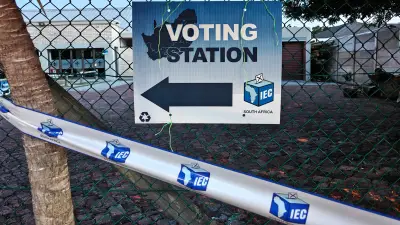
South Africa voted on 4 November in its seventh local government election, with 29.2 million registered voters, 546 parties and nearly 137,000 candidates for 257 councils (SAnews, 2 November). With 87% of the 23,696 voting districts counted by mid-afternoon on 6 November, the ANC had 31.9% of the proportional vote, the DA 24.2%, Jacob Zuma's MK 9.4% and the EFF 6.3%, on a turnout of 51.3% against 45.9% in 2021, when the ANC took 45.6%; the DA led in six of the eight metros, MK in eThekwini and the ANC in Buffalo City alone, and the IEC declares the result on Sunday 8 November (The Outlier, from IEC data).
5 sources
 Lumumba said history would speak — in Congo this week, two men grabbed the pen
On 13 October Joseph Kabila — president from 2001 to 2019, sentenced to death in absentia for treason by a military court in 2025 — launched the Front for the Refoundation of the Nation (FRN) at a news conference in rebel-held Goma, taking the head of a coalition that includes the Rwanda-backed M23, with the AFC's Corneille Nangaa among his deputies (Al Jazeera, 13 October). Two days later Interior Minister Jacquemain Shabani banned the activities of 13 political parties across the country, including Kabila's PPRD and Augustin Matata Ponyo's LGD, in a notice that states no legal ground, duration or dissolution (Actualité.cd, 15 October).
3 sources
 Mozambique's Rome peace turns 34 — it held by turning an army into a party
On 4 October 1992 in Rome, President Joaquim Chissano and Renamo's leader Afonso Dhlakama signed the General Peace Agreement that ended 14 years of civil war; a UN mission of some 6,500 troops and observers then oversaw the demobilisation of more than 76,000 soldiers and Mozambique's first multiparty elections, held from 27 to 29 October 1994, in which Renamo won 37.8% of the legislative vote and Dhlakama 33.7% of the presidential one (United Nations, ONUMOZ). Renamo returned to arms in October 2013 after a government raid on its camp, and a new accord was signed in Maputo on 6 August 2019 by President Filipe Nyusi and Renamo's leader Ossufo Momade (Mail & Guardian, 8 August 2019).
3 sources