 KemetLeads
Morocco votes Wednesday — four fixtures this week, none that can change a head of state

Morocco votes Wednesday — four fixtures this week, none that can change a head of state
Morocco votes on 23 September for the 395 seats of the House of Representatives, with 15,801,162 registered voters, 28 parties and 7,288 candidacies on 1,850 lists (Maroc.ma, the government portal, 21 September). The same day the South African Reserve Bank announces its Monetary Policy Committee decision with the repo rate at 7.00%; the ECOWAS Court of Justice sits in Dakar for its international conference until 25 September; and the UN General Assembly's general debate runs from 22 to 28 September.
The only ballot of the week elects a parliament, not a head of state: under the 2011 constitution the King appoints the head of government from the party that wins, while defence, religion and the judiciary stay with the throne — which is why a 395-seat contest can be both real and bounded. Our Power block is why that distinction is worth stating plainly: of the 54 leaders we grade, 38 came to power by the rules, but among the 39 whose time in office is finished only 13 both arrived and left by them. The second number is on the Moroccan roll itself — 18-to-24-year-olds are 4% of the 15.8 million registered and the over-60s are 29% — so the electorate voting on Wednesday is older than the country it will speak for. The same day's quieter fixture may reach those voters faster: Cyril Ramaphosa's Reserve Bank decides with the repo rate at 7.00%, for an economy whose development delivery we put at the 10th percentile of African countries since 2018, GDP per head down 4% while the median African country's rose 1%. We said in July that 2026's ballot year is a referendum on how leaders leave, and the real test of this particular week is not turnout in Rabat: it is whether Félix Tshisekedi's parliament in Kinshasa moves on a referendum date while the cameras are pointed at New York.
Morocco's provisional results on 24 September and which party the King asks to form a government; the Reserve Bank's next decision is 19 November.
SourcesMaroc.ma, government portal — 2026 legislative elections, key figures, 21 Sep · South African Reserve Bank, Monetary Policy Committee announcement dates, 23 Sep · ECOWAS Court of Justice on its Dakar conference, 21–25 Sep
More from the Brief
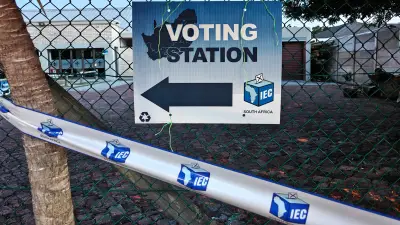 ANC falls to 32% in South Africa's local elections — the voters came out to leave it
South Africa voted on 4 November in its seventh local government election, with 29.2 million registered voters, 546 parties and nearly 137,000 candidates for 257 councils (SAnews, 2 November). With 87% of the 23,696 voting districts counted by mid-afternoon on 6 November, the ANC had 31.9% of the proportional vote, the DA 24.2%, Jacob Zuma's MK 9.4% and the EFF 6.3%, on a turnout of 51.3% against 45.9% in 2021, when the ANC took 45.6%; the DA led in six of the eight metros, MK in eThekwini and the ANC in Buffalo City alone, and the IEC declares the result on Sunday 8 November (The Outlier, from IEC data).
5 sources
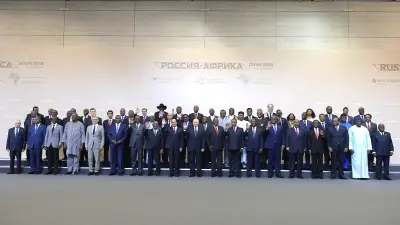 Russia–Africa summit ends in Moscow — 48 delegations, 21 leaders, three texts adopted
Vladimir Putin closed the third Russia–Africa Summit in Moscow on 29 October with three texts adopted — the Moscow Declaration, a Partnership Forum action plan for 2027–2029 and a declaration on artificial intelligence — and told the plenary that Russia has military and military-technical agreements with 45 African countries (Kremlin, 29 October). Forty-eight delegations came; the Kremlin had announced 22 heads of state (TASS, 26 October), AP counted about 20 and Putin said 21 at his closing press conference, against 43 at Sochi in 2019 and 17 in St Petersburg in 2023.
12 sources
 Lumumba said history would speak — in Congo this week, two men grabbed the pen
On 13 October Joseph Kabila — president from 2001 to 2019, sentenced to death in absentia for treason by a military court in 2025 — launched the Front for the Refoundation of the Nation (FRN) at a news conference in rebel-held Goma, taking the head of a coalition that includes the Rwanda-backed M23, with the AFC's Corneille Nangaa among his deputies (Al Jazeera, 13 October). Two days later Interior Minister Jacquemain Shabani banned the activities of 13 political parties across the country, including Kabila's PPRD and Augustin Matata Ponyo's LGD, in a notice that states no legal ground, duration or dissolution (Actualité.cd, 15 October).
3 sources